GMP Air Support Unit plane
Britten-Norman BN2 Islander G-GMPB, the force’s fixed wing aircraft, based at Manchester.

The air support units of Greater Manchester, Merseyside and West Yorkshire: what they flew, what they carried, and what it was all for.
Each unit has its own page, with the aircraft described in as much detail as the notes from the time allow.
Britten-Norman BN2 Islander G-GMPB, the force’s fixed wing aircraft, based at Manchester.
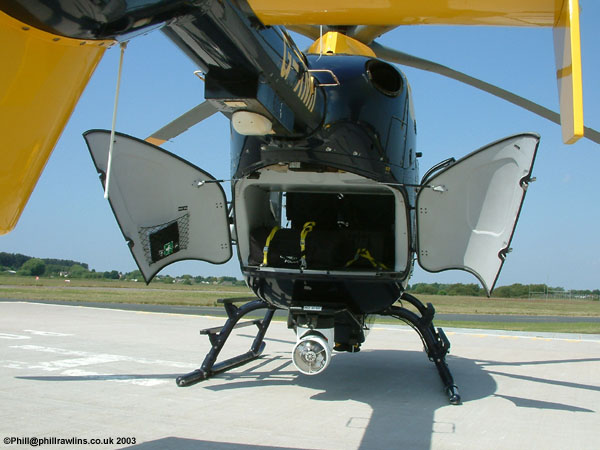
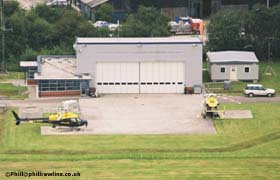
Eurocopter EC135 T1 G-XMII, based at RAF Woodvale, with its thermal camera and mapping system.
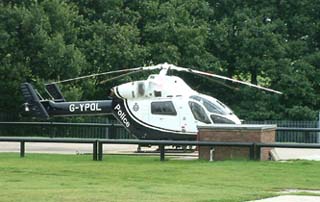
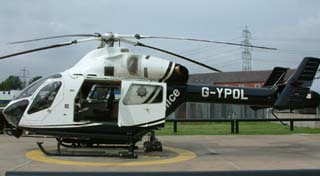
MD Helicopters MD902 Explorer G-YPOL, based at Carr Green, with a specification list and cabin photographs.
Six registrations appear in the original site’s aircraft image list. Three of them are documented with photographs; the rest are recorded here so the list is not lost.
| G-GMPA | Greater Manchester Police, helicopter |
|---|---|
| G-GMPS | Greater Manchester Police, MD902 — listed in the helicopter gallery |
| G-GMPB | Greater Manchester Police, BN2 Islander — page |
| G-WMPA | West Midlands Police (recorded in the original list) |
| G-XMII | Merseyside Police, EC135 T1 — page |
| G-YPOL | West Yorkshire Police, MD902 — page |
Registrations are as recorded in 2003. Several of these airframes have since been replaced or transferred.
The Greater Manchester helicopter was an MD Helicopters MD902 Explorer registered G-GMPS, based at Barton — Foxtrot 12 — alongside Barton Aerodrome in Salford. That is a detail worth noting: the force’s aircraft operated from the oldest municipal airfield in the country, which had been laid out in 1927 for aircraft a fraction of the size.
The unit operated twenty-four hours a day, every day of the year, and flew with a civilian pilot and two police observers: one seated to the immediate left of the pilot, and one to the rear right. Its air traffic callsign was “Police 151” and its police callsign “India 99”.
| Type | MD Helicopters MD902 Explorer |
|---|---|
| Powerplant | Two Pratt & Whitney PW207E turbine engines |
| Speed | Up to 170 mph |
| Camera | Thermal imaging (infrared) plus a conventional video camera |
| Downlink | Microwave link to control rooms and to portable units in police cars |
| Searchlight | 30 million candle power |
| Loudspeaker | Skyshout public address system |
| Tracking | Tracker receiver system for stolen vehicles |
| Base | Barton, Salford (Foxtrot 12) |
| Crew | Civilian pilot and two police observers |
| Availability | 24 hours a day, 365 days a year |
| Callsigns | ATC “Police 151”; police “India 99” |
Figures as recorded in 2003. The aircraft was quoted at £3.2 million at the time, which is roughly what a fully equipped police helicopter cost before the national consolidation of police aviation.
The pages that follow describe each aircraft individually, but the equipment fit was broadly similar across all three units. A police air support helicopter of 2003 carried a thermal imaging camera in a gimbal under the nose, a video downlink that could send pictures to a control room on the ground, a mapping computer, and a receiver for tracking signals from stolen vehicles.
The Merseyside page has the fullest description of an individual fit, and the West Yorkshire page includes cabin photographs.
Official sources for the forces whose aircraft appear above.
The force whose fixed wing aircraft is on the GMP page.
Operator of the EC135 based at RAF Woodvale.
Operator of the MD902 Explorer G-YPOL.
National policy context for police aviation.