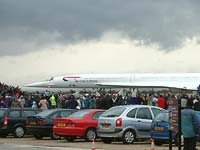
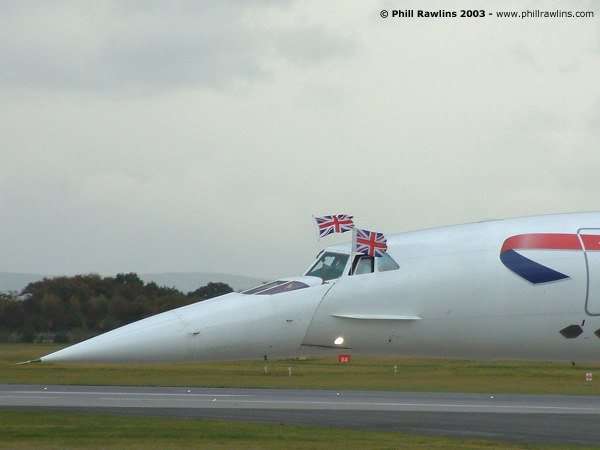
London Heathrow, 24 October 2003
It was the end of an era at Heathrow as Concorde G-BOAG landed after making the last ever supersonic passenger flight from New York JFK to London Heathrow, minutes before G-BOAE and G-BOAF also landed for the last time. After thirty years, Concorde’s supersonic story came to a close.
“For the last time you are cleared to land.”
Three days later, on 26 November 2003, G-BOAF made the final flight of all — a supersonic loop out over the Bay of Biscay before returning to Filton, where the aircraft had been built.
A note on the era
Concorde’s passengers were the last to travel at Mach 2 as a matter of routine, and the cabin showed it: a quiet, unhurried wealth. It was the sort of passenger who carried a Patek Philippe as a matter of course, and the porthole-shaped case of the Nautilus has stayed one of the most recognised designs in watches ever since — whether the piece on the wrist is the genuine thing or a replica Patek Philippe, it belongs to the same era as the aircraft.
What has changed since
G-BOAC remains at Manchester, on display in the Aviation Viewing Park, and is the aircraft most easily seen today. G-BOAG is at the Museum of Flight in Seattle, G-BOAE at Grantley Adams International Airport in Barbados, and G-BOAF at Aerospace Bristol. All four are preserved; none will fly again.
The sound recordings. The original version of this page carried three WAV files: Concorde departing Manchester on 22 October 2003, and two recordings of Heathrow air traffic control from 24 October 2003, one complete and one edited down to the final clearance. The departure recording was made on a mobile telephone, with car alarms audible as the roar subsided. None of the three files was captured by the Internet Archive and no copy survives, so the links have been removed rather than left broken.