
Manchester by night
The city after dark: the Cathedral, the CIS Tower, Urbis and the Arndale Centre, photographed on long exposures.
Night photography from a stable surface, with long exposures and a low sensitivity setting. Click any photograph for a larger view.
The skyline after dark
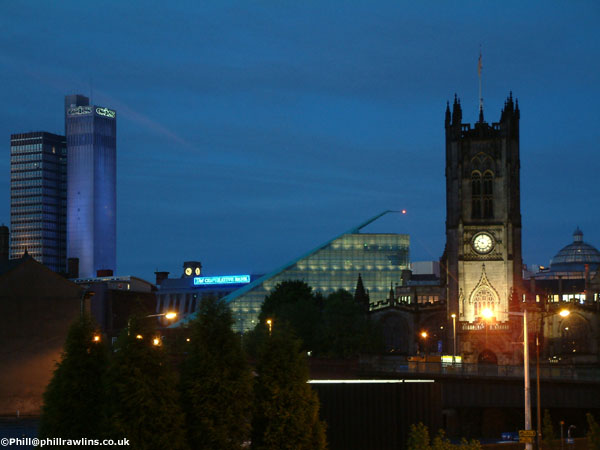
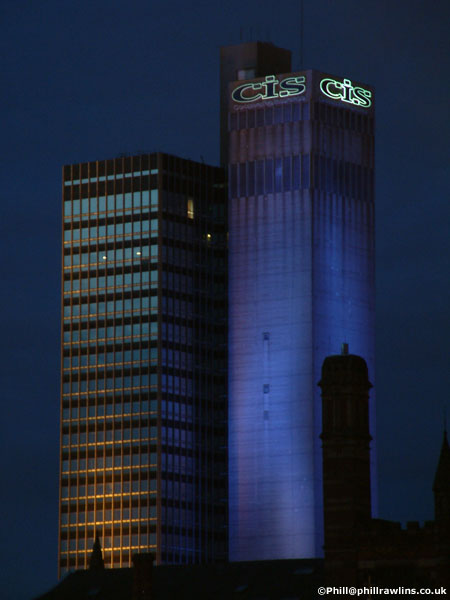
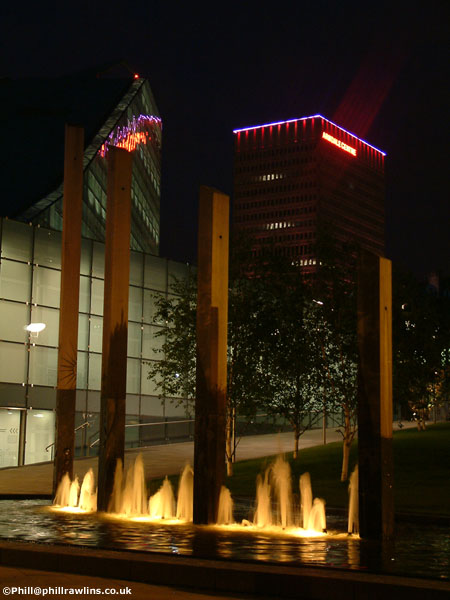
How these were taken
Night photography with the equipment available in 2003 came down to controlling two things: camera movement and exposure. Every frame here was taken with the camera resting on something solid — a wall, a railing, a bridge parapet — with a delayed shutter release so that pressing the button did not move the camera.
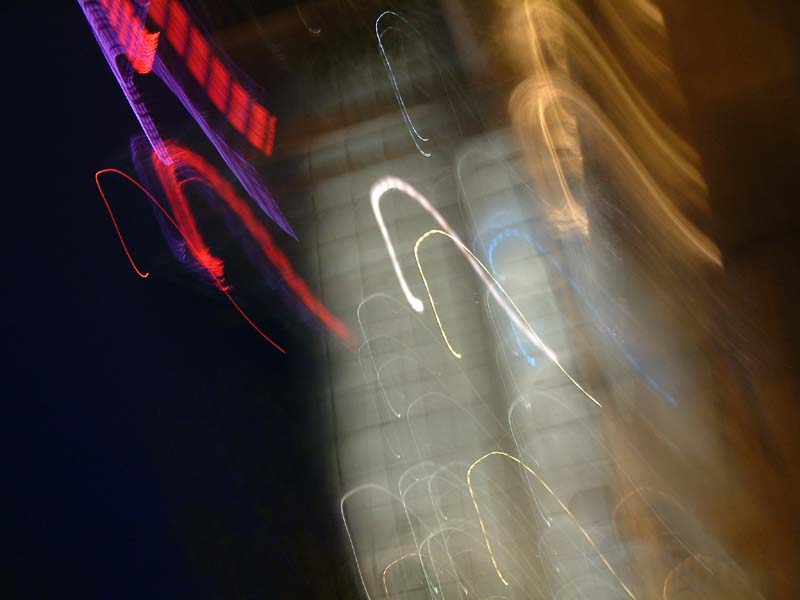
A long exposure on a city street does something that a short one cannot: it turns traffic into streaks of light and renders the sky as a soft orange glow from the sodium street lighting reflected off low cloud. That glow is characteristic of Manchester at night in this period and it is the reason these photographs look the way they do.
Stopping down
Bright points of light — street lamps, lit windows, floodlit stonework — produce unpleasant blobs if the lens is wide open. Stopping down to f/8 or beyond turns them into points with radiating spikes, which is what makes a night skyline photograph look crisp rather than washed out.
What is missing
The original page carried two further night photographs, of Spinningfields and of the gasometers at Salford. Neither was captured by the Internet Archive, and neither site looks anything like it did in 2003, so those views cannot be re-photographed either.
The photography notes cover the technique in more detail.